Carbon Cycling in Cropping Systems
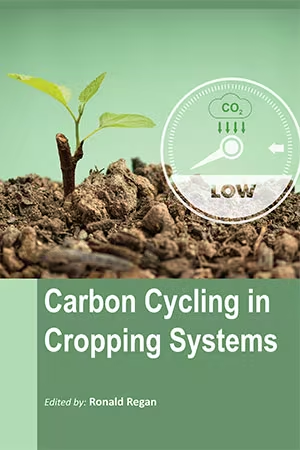
Ronald Regan | 2023 | ISBN: 1682518884 | English | 290 pages | True PDF | 16 MB
Carbon (C) is one of the most common elements in the universe and found virtually everywhere on earth: in the air, the oceans, soil, and rock. Carbon is part of geologic history in rock and especially the ancient deposits that formed coal, oil and other energy sources we use today. In an agricultural system, carbon is cycled through the atmosphere, through plants and animals, and through the soil. The production of food affects the amount of carbon in the soil as harvesting plant and animal products removes carbon from the agricultural system. Agricultural soils are among the largest terrestrial carbon (C) reservoirs and have great potential to mitigate atmospheric C02. Understanding C cycling processes in cropping systems would improve mechanism understanding and model predicting of the C fate in the agriculture ecosystem and is urgently needed to better assess the role of agriculture within the Earth system. Agriculture strongly impacts the global carbon (C) and nitrogen (N) cycles through land-use change and the agronomic management. Unlike natural ecosystems, where the C and N cycles are generally closely coupled, in the agricultural systems farmers profoundly alter the stoichiometric relations between C and N fluxes through practices, such as soil cultivation, N fertilization, use of cover crops or N-fixing crops, and so on. This alteration determines a potential for depletion or accumulation of these two elements in agricultural soils. Thus, for example, soil processes, such as nitrate leaching or emissions of N20 via denitrification would tend to restore stoichiometry by releasing the N in excess. Evidently, such processes can have deleterious, far-reaching consequences for the environment and human health. In this regard, agricultural soils are one of the major contributors to greenhouse gas (GHG) emissions, accounting for about 10-12% of total anthropogenic GHG. Consequently, there is currently a great interest in developing agronomic practices to minimize C and N losses in order to mitigate their associated negative environmental impacts (e.g., acidification, eutrophication, and GHG emissions). An increased retention of C and N in soil could be achieved through the adoption of integrated management strategies that allow for a recoupling of C and N cycles.
This book contains a lot of information that will be completely new to most of us, and is still explained in a way that is very easy to understand. This book is framed around carbon cycling, but it necessarily includes so much more. You will learn a more integrated explanation of how the soil, microbe, and plant ecosystem actually works than you can find anywhere else. You will learn how soils form and function, and why two centuries of agriculture has eroded and depleted many of them. Then explore how regenerative agriculture can restore soil health, fix water quality problems, increase drought and pest resilience and increase farm profits. Explore how soils can store carbon and how much might be sequestered by using new practices.
Quick check before we show the links
Helps us keep automated scrapers from hammering the filehosts.