Certified Management Accountant (CMA) Mastery for Success

Published 6/2026
MP4 | Video: h264, 1920x1080 | Audio: AAC, 44.1 KHz, 2 Ch
Language: English | Duration: 1h 23m | Size: 1.27 GB
CMA, ACCA, CFA Essentials: Planning, Control, Analytics, Strategic Decisions, Budgeting, Costing, & Financial Strategy.
What you'll learn
Understand the role of management accounting in organizational strategy and decision-making.
Explain the principles of financial reporting, income measurement, and revenue recognition.
Develop strategic plans, budgets, and comprehensive master budgets for business operations.
Analyze cost behavior and apply various cost measurement techniques in managerial decision-making.
Differentiate between absorption costing and variable costing methods and evaluate their applications.
Perform variance analysis to evaluate operational efficiency and cost performance.
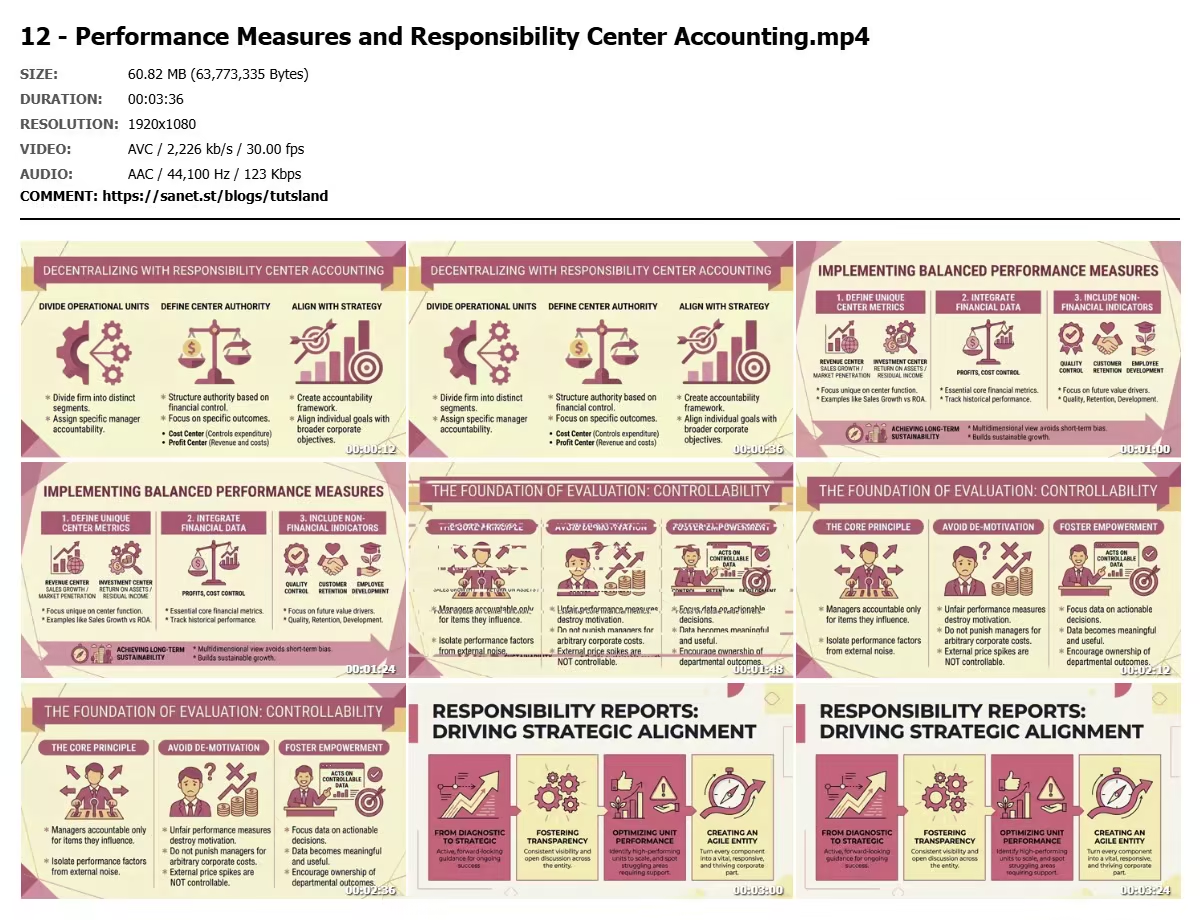
Use performance measurement frameworks and responsibility accounting to assess organizational results.
Understand corporate governance, risk management, and compliance principles in financial environments.
Evaluate and design effective internal control systems and control frameworks.
Utilize technology-enabled financial analytics to support business decisions.
Apply marginal analysis techniques for short-term business decision-making.
Assess pricing strategies and implement target costing methodologies.
Identify financial risks and incorporate risk assessment into strategic decision-making.
Integrate accounting, finance, technology, and analytical skills to support organizational performance and long-term business success.
Requirements
No prior experience in management accounting or financial planning is required.
Willingness to learn financial analysis, budgeting, costing, and performance management techniques.
Interest in business strategy, financial decision-making, and organizational performance improvement.
Description
This course contains the use of Artificial Intelligence.
[[ Unofficial Course ]]
Financial planning, performance management, and strategic decision-making are among the most important skills required in today's business environment. Organizations rely on financial professionals not only to record and report financial information but also to analyze data, support strategic initiatives, manage costs, improve performance, and help guide long-term business success. This comprehensive course is designed to provide a strong foundation in management accounting, financial planning, budgeting, performance measurement, internal controls, financial analytics, and strategic financial management.
Throughout the course, you will explore the role of management accounting in supporting organizational strategy and decision-making. You will learn how financial information is generated, interpreted, and used by managers to evaluate performance and create value. The course covers the principles of external financial reporting, income measurement, revenue recognition, strategic planning processes, and the development of comprehensive budgeting systems that support organizational objectives.
You will gain a deep understanding of cost measurement techniques and costing methodologies used in modern organizations. Topics such as cost behavior analysis, absorption costing, variable costing, job order costing, process costing, and activity-based costing will help you understand how costs are accumulated, allocated, and managed. You will also learn how variance analysis and responsibility accounting are used to evaluate operational efficiency and managerial performance.
In addition to traditional accounting concepts, this course examines the critical role of governance, risk management, and internal control systems in protecting organizational assets and ensuring reliable financial reporting. You will study internal control frameworks, systems security principles, compliance requirements, and the importance of effective corporate governance practices. The course also introduces modern enterprise technologies, including Enterprise Resource Planning (ERP) systems, data governance principles, and technology-enabled financial analytics that support data-driven decision-making.
The course further develops your ability to analyze financial statements, evaluate profitability, interpret key financial ratios, and assess business performance. You will learn how managers use financial analysis techniques to identify opportunities, manage risks, and make informed strategic decisions. Practical concepts such as marginal analysis, pricing strategies, target costing, and capital budgeting will equip you with the tools needed to evaluate investments, allocate resources efficiently, and support organizational growth.
By combining accounting principles, financial analysis, performance management, technology, and strategic decision-making, this course provides a well-rounded understanding of how financial information supports business success. Whether you are pursuing a career in accounting, finance, management, consulting, business analytics, or corporate leadership, this course will help you build the analytical and managerial skills needed to thrive in today's competitive business environment.
Upon completion, you will have the knowledge and confidence to participate in financial planning processes, develop budgets, analyze costs, evaluate performance, strengthen internal controls, interpret financial data, and contribute to strategic business decisions that drive organizational value and sustainable growth.
Thank you
Who this course is for
Students who want to build a strong foundation in financial planning, management accounting, and business performance management.
Accounting and finance professionals seeking to strengthen their budgeting, costing, and financial analysis skills.
Managers and supervisors who need to understand financial information for better decision-making and performance evaluation.
Business owners and entrepreneurs who want to improve financial planning, cost control, and profitability.
Professionals preparing for management accounting, finance, or business-related certifications and examinations.
Financial analysts and business analysts looking to enhance their understanding of performance measurement and strategic financial management.
Internal auditors, compliance professionals, and risk managers interested in governance, internal controls, and financial oversight.
ERP and business systems professionals who want to understand the financial processes supported by enterprise technologies.
Individuals interested in learning how financial data, analytics, and accounting information support organizational success.
Quick check before we show the links
Helps us keep automated scrapers from hammering the filehosts.