Small Modular Reactors: The Rolls-Royce SMR
Published 5/2026
MP4 | Video: h264, 1920x1080 | Audio: AAC, 44.1 KHz, 2 Ch
Language: English | Duration: 7h 22m | Size: 9.37 GB
GDA, Design, Safety, Economics & the UK Deployment Programme – For Engineers
What you'll learn
Explain why SMRs are emerging now — the energy trilemma, why conventional large nuclear stalled, and what the factory-built model changes
Describe PWR nuclear physics at an engineering level — fission, criticality, moderation, the Rankine cycle, and efficiency calculations
Walk through the Rolls-Royce SMR design — primary circuit, pressuriser, steam generators, reactor core, containment, and passive safety
Understand the UK Generic Design Assessment — all four GDA steps, Rolls-Royce's Step 3 position, the March 2026 RJD, and what Step 4 requires
Explain the factory-built model — 16m × 4m modules, 90% off-site manufacturing, the Sheffield facility, and the 500-day on-site target
Assess the SMR economic case — £2–3bn per unit, £250bn export ambition, NWF loan, CEZ stake, and the learning curve cost trajectory
Navigate the Wylfa deployment programme — GBE-N selection, the April 2026 contract, 2029 FID criteria, and the path to mid-2030s first power
Compare the RR SMR against rivals — NuScale VOYGR, BWRX-300, EDF SMR — on output, regulatory maturity, cost certainty, and timeline
Evaluate the honest criticisms — cost uncertainty, construction timeline risk, waste per MWe, and the 'too large to be a true SMR' argument
Apply this knowledge immediately — reading GDA documentation, evaluating programme claims, advising clients, and positioning for UK nuclear
Requirements
Familiarity with energy systems is useful but not required — the course starts from the energy trilemma and builds the nuclear context from first principles
No prior nuclear experience is needed — the nuclear physics section covers everything required before the design and regulatory sections
No software tools required — this is a conceptual, applied, and policy-informed engineering course, not a reactor simulation tutorial
Engineers at any career stage will benefit: early-career professionals building their nuclear foundation, mid-career engineers transitioning into nuclear or energy, and senior engineers who need a structured, current briefing on the Rolls-Royce SMR programme
Description
Nuclear engineers know reactors. This course teaches you the one reactor that is actually being built.
The Rolls-Royce SMR is the most advanced small modular reactor programme in Europe — 18 months ahead of every competitor in Generic Design Assessment, a signed contract with Great British Energy – Nuclear, a confirmed site at Wylfa, and a Final Investment Decision expected in 2029. It is no longer a concept. It is a programme.
Yet most engineers working in or around the UK energy sector have never had a structured, technical explanation of what the Rolls-Royce SMR actually is, how it works, why it costs what it costs, how it is regulated, and what has to happen before concrete is poured at Wylfa. This course fills that gap.
Across seven core sections and approximately seven hours of instruction, you will build a systematic, engineering-grade understanding of the Rolls-Royce SMR from first principles. You will start with why small modular reactors are emerging now — the energy trilemma, the failure of conventional large nuclear, and why the factory-built model changes everything — before moving into the physics, the design, and the deployment.
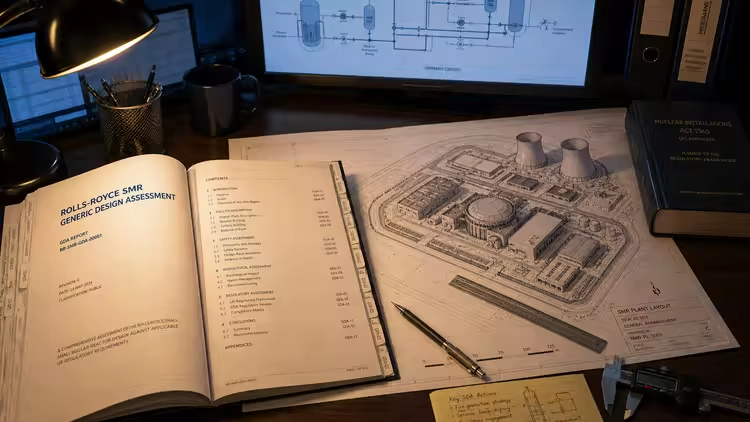
The design deep dive is the core. You will walk through the 470 MWe pressurised water reactor component by component — the three-loop primary circuit, pressuriser, steam generators, reactor core, control and instrumentation (including the Yokogawa CENTUM VP contract), containment, and passive safety systems — using the published Rolls-Royce SMR plant layout and GDA documentation as your reference.
The factory-built revolution section explains the central innovation: approximately 90% of manufacturing off-site, 16m × 4m transportable modules, a 500-day on-site construction target, and the Sheffield manufacturing facility. You will understand what this means for cost, schedule, and quality — and where the risks remain.
Safety and regulation demystifies the UK Generic Design Assessment: what Step 3 means for Rolls-Royce, what the March 2026 Regulatory Justification Decision represents, and what must happen before a site licence is granted at Wylfa. The section covers defence-in-depth, ONR and Environment Agency roles, waste categories, and how UK GDA status supports the Czech Republic and Sweden regulatory engagements.
The Wylfa deployment section follows the real programme: the GBE-N selection process, the April 2026 contract, the National Wealth Fund £760m loan, the CEZ Group Czech contract, the 2029 Final Investment Decision criteria, the construction timeline to mid-2030s first power, and the £54bn economic impact forecast.
Five expansion modules add depth for engineers who need it: primary systems engineering calculations, project finance and LCOE analysis, digital I&C and cybersecurity, environmental lifecycle and waste, and beyond-electricity applications including nuclear hydrogen, district heating, and desalination.
Every lesson is built for engineers working in or near the nuclear sector — reviewing GDA documentation, writing procurement specifications, assessing technical bids, advising clients, or simply needing a rigorous technical foundation before the UK's biggest infrastructure programme of the next decade goes into construction.
Built by a practising engineer with over fifteen years delivering safety-critical projects across energy infrastructure. If you work in nuclear, energy, or engineering — or you want to — this is the course that puts the Rolls-Royce SMR in your professional toolkit.
Who this course is for
Nuclear engineers and nuclear graduates who want a structured technical briefing on the specific reactor design that will define the UK's nuclear programme for the next 60 years
Mechanical, electrical, civil, and systems engineers entering or moving into the nuclear supply chain who need to understand the design they will be working on
Energy consultants, policy analysts, and investment professionals who need engineering-grade understanding of the Rolls-Royce SMR before advising clients or allocating capital
Project engineers and EPC professionals joining the GBE-N programme, the Wylfa site, or the Rolls-Royce supply chain who need rapid programme intelligence
Procurement, commercial, and contracts professionals in nuclear who need to understand what they are buying before they can specify, evaluate, or negotiate it
Anyone working in UK energy who wants to understand the programme that will dominate infrastructure investment between now and 2040 — and position their career accordingly
Quick check before we show the links
Helps us keep automated scrapers from hammering the filehosts.